
Reliable Telecoms for Charities: Improving Helpline Performance and Service Delivery

Reliable Telecoms for Charities: Improving Helpline Performance and Service Delivery
What Happens When Someone Reaches Out for Help and the Call Doesn’t Get Through?
For charities, communication failures are more than an inconvenience.
A missed call could mean a vulnerable individual unable to access support. Poor call quality can create frustration during sensitive conversations. System outages can disrupt critical services and place additional pressure on already stretched teams.
Whether operating a crisis helpline, community support service, safeguarding programme, or fundraising operation, charities depend on reliable communications to fulfil their mission.
Yet many organisations continue to rely on fragmented telecom systems, multiple suppliers, and outdated infrastructure that make delivering consistent support increasingly difficult.
As service demands continue to grow, reliable telecoms have become a strategic necessity rather than simply an operational requirement.
Why Many Charities Struggle with Communications
The charitable sector faces unique challenges that differ significantly from commercial organisations.
Charities must balance service delivery, accessibility, safeguarding responsibilities, and budget constraints, often with limited internal IT resources.
Common challenges include:
- Multiple telecom contracts across departments and locations
- Rising communication costs
- Poor call quality and dropped calls
- Limited visibility into usage and performance
- Difficulties supporting hybrid and remote teams
- Staff and volunteer turnover requiring regular training
- Increasing demand on helplines and support services
While these issues may appear operational on the surface, they can directly impact service users, staff productivity, and organisational effectiveness.
How JUNO Women’s Aid Improved Reliability and Reduced Complexity
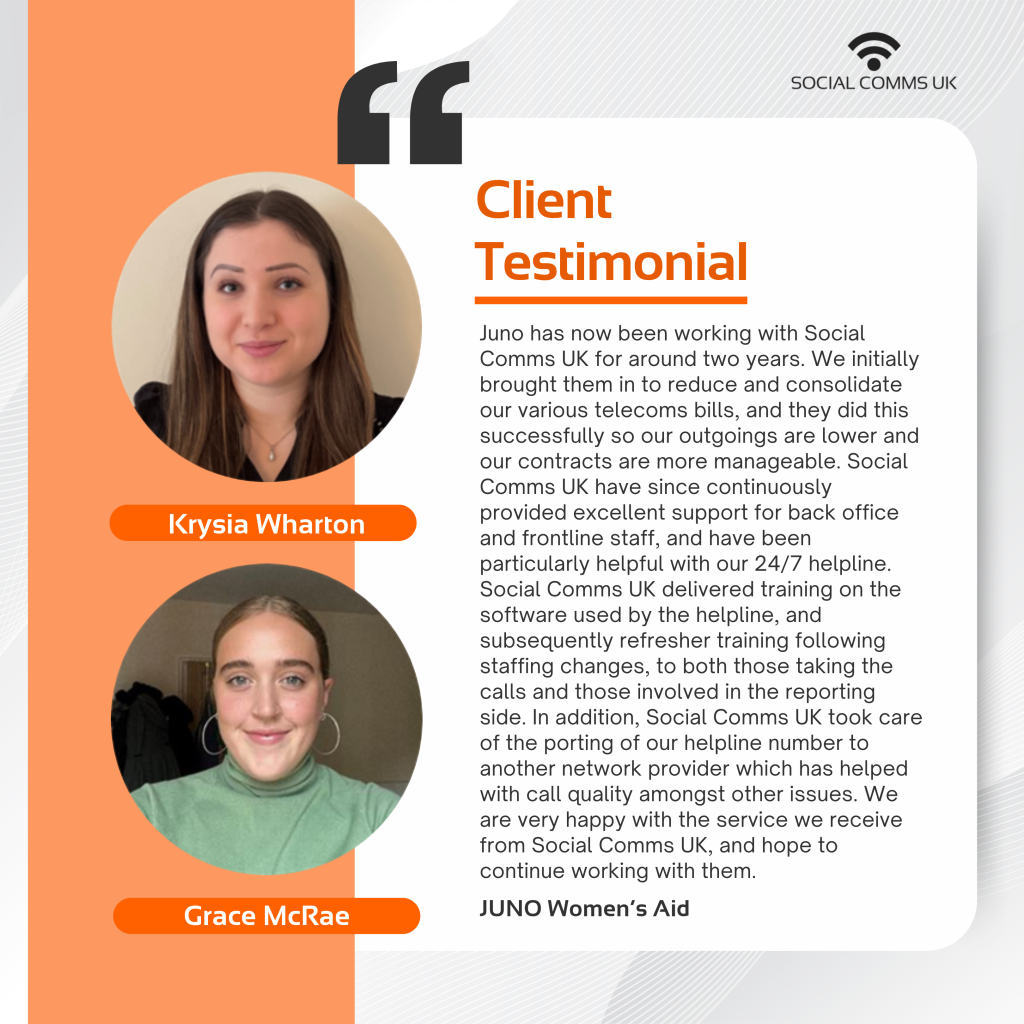
A strong example of the impact reliable telecoms can have comes from JUNO Women’s Aid.
Initially, JUNO approached Social Comms UK seeking support to reduce and consolidate various telecom bills and contracts across the organisation.
What began as a cost-saving initiative quickly evolved into a broader communications improvement project.
Through a more streamlined telecom strategy, JUNO was able to simplify contract management, improve call quality, and create a more reliable communications environment for both frontline and back-office teams.
Additional support included:
- Training for helpline staff
- Refresher sessions following staffing changes
- Support with reporting requirements
- Number porting to a new network provider
- Ongoing technical assistance
- Enhanced support for their 24/7 helpline services
The result was a communications infrastructure better aligned with the organisation’s operational needs while helping staff focus on supporting those who depend on their services.
Their experience highlights an important lesson for charities: telecommunications should not simply be viewed as a utility expense. They should be treated as a strategic asset that enables service delivery.
Why Telecom Reliability Matters for Charity Helplines
For organisations operating support lines, every interaction matters.
Whether supporting victims of domestic abuse, providing mental health assistance, offering community care services, or responding to urgent enquiries, reliable communication can directly affect outcomes.
A dependable telecom solution helps organisations:
- Reduce missed calls
- Improve caller experiences
- Maintain service continuity
- Support staff working across multiple locations
- Ensure critical calls reach the right people
- Monitor performance through reporting and analytics
In environments where trust and accessibility are essential, communication reliability becomes a core component of service quality.
Beyond Phone Systems: The Role of Modern Telecom Solutions
As charities expand services, support hybrid teams, and respond to increasing demand, communication systems must do more than simply connect calls. Modern telecom solutions help organisations remain accessible, responsive, and resilient while continuing to deliver vital support services.
Cloud Telephony
Enables helpline staff, outreach workers, and remote volunteers to make and receive calls from any location while maintaining a consistent and professional experience. This helps ensure service users can continue accessing support regardless of where staff are working.
Unified Communications
Brings voice, messaging, video meetings, and collaboration tools together in a single platform, helping teams communicate more effectively, reduce delays, and coordinate support services more efficiently.
Business Continuity
Ensures critical support services remain available during office closures, network disruptions, or unexpected events. By maintaining accessibility during challenging circumstances, charities can continue supporting vulnerable individuals when they need assistance most.
Advanced Reporting
Provides valuable insight into call volumes, response times, service demand, and operational performance. This allows managers to make informed decisions, allocate resources effectively, and identify opportunities to improve service delivery.
Scalability
Allows organisations to adapt their communications infrastructure as services grow, programmes expand, or demand increases. This flexibility helps charities maintain service quality while supporting future development and organisational growth.
These capabilities help charities remain agile, improve accessibility, and maintain high standards of service delivery while focusing resources where they are needed most.
Reducing Costs Without Compromising Support
One of the most common misconceptions is that improving telecom infrastructure requires significant investment.
In reality, many charities can achieve cost savings while improving performance.
Opportunities often include:
- Consolidating multiple suppliers
- Eliminating unnecessary services
- Replacing outdated hardware
- Migrating to cloud-based systems
- Optimising usage and contracts
For charities operating under increasing financial pressure, these efficiencies can free up resources that can be redirected towards frontline services.
Future-Proofing Charity Communications
The demands placed on charities continue to evolve.
Growing service expectations, hybrid working models, digital transformation initiatives, and increasing operational complexity all place greater demands on communication systems.
Forward-thinking organisations are investing in telecom strategies that help them:
- Improve accessibility
- Enhance safeguarding processes
- Strengthen service continuity
- Support distributed teams
- Deliver better experiences for service users
- Control operational costs
Reliable communications are no longer simply about making and receiving calls. They are about enabling organisations to deliver their mission effectively.
Is Your Charity’s Telecom System Supporting or Holding Back Your Mission?
If your organisation is managing multiple telecom suppliers, struggling with call quality issues, operating outdated systems, or facing increasing communication costs, it may be time to review your current setup.
Social Comms UK can help identify practical opportunities to:
✓ Reduce telecom costs
✓ Improve helpline reliability
✓ Consolidate contracts and suppliers
✓ Support hybrid and remote teams
✓ Enhance service continuity
✓ Improve overall communication performance
Book a free charity telecoms assessment today and discover how your communications infrastructure can better support the people who rely on your services.
Contact us today: 0330 320 3445
Visit: https://socialcomms.uk/